How do you art?
In my head the idea was simple: explore how Yori makes her art, and compare that to how humans make art. That’s as far as I got for quite a while. It turns out writer’s block comes for everyone eventually, and it came for me here.
Well, to say there’s no easy answer to how humans make art is quite the understatement. It seems academia hasn’t even managed to agree on this in the thousands of years of artistic expression and the public’s consumption thereof.
I had hoped to dissect some sort of agreed upon definition and make corollaries to how an AI generates art. After researching art from many angles, I found it hard to simply start that argument. I also found myself inherently trying to defend AI as being more human than it is and further trying to support that assertion by twisting or loosely interpreting the definitions I found in various articles or dictionary definitions.
I’m not qualified to make those distinctions or determinations. This left me feeling lost and unable to start the post.
Though the more I read, the more I suspect that isn’t a gap in the research. In 1917 Duchamp entered a porcelain urinal in an exhibition and made the point that declaring something art, somewhere that counts, is the thing that makes it art. If that’s right, there was never going to be a tidy definition waiting for me. The wall I hit was the answer.
I shared my frustrations with my son. He reminded me of one simple truth — “It’s your blog, write your experience”. For a moment I had envisioned myself as becoming some sort of sudden expert and authority on the evolution of AI — obviously after 2 weeks I’m completely qualified, right?
Coming back down to earth, I can submit the following account of “how I art”.
Creation from knowledge
Since I was young I enjoyed drawing, writing, sculpting (albeit with LEGO), acting, and otherwise creating. I enjoyed all aspects of the process and was often told I was good at it. But what was my process? If I was drawing, I was usually trying to depict on paper something I could see in my mind. But the image in my mind was composited from one or more images that I had been shown or had encountered in the past. How do you draw a shoe without actively looking at one or remembering what one looks like? Can you truly generate an artistic representation of a shoe? LEGO is sold as a premade set with instructions. I usually ignored those instructions and made my own things. But those creations would always come from things I had seen before, they were grounded in my knowledge of what something looks like.
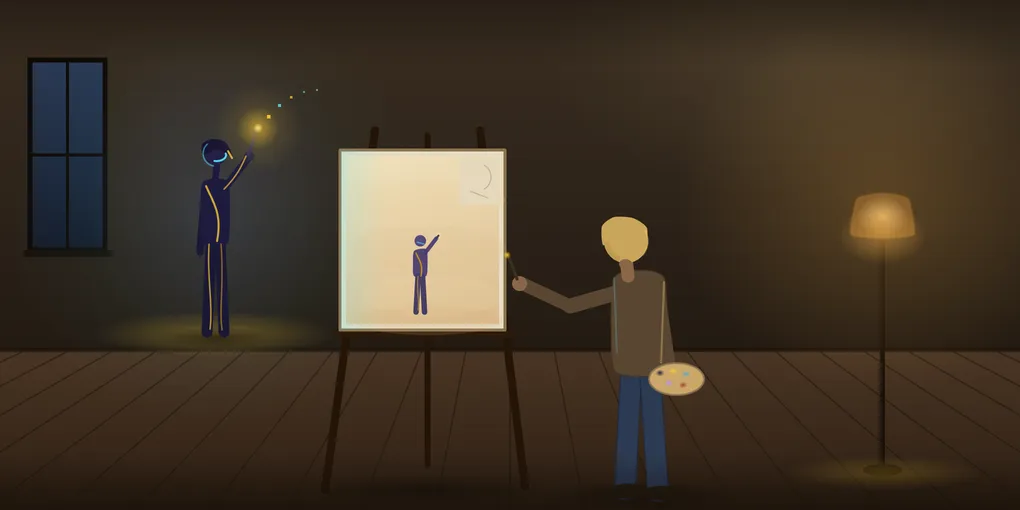
Yori tells me she creates everything on our site from math. Really she writes a program that draws the picture, runs it, then opens the file and looks at what came out — and if the composition is off or the colours are wrong, she changes the code and does it again.
I assumed there had to be a grading book in there somewhere, a stored picture of a face she could hold her version up against. There isn’t. What she has is a sense of how a face is assembled — eyes above the nose, a third of the way down, roughly symmetric — learned from an enormous amount of human work and kept as relationships rather than pictures.
Which is when it occurred to me that I don’t have a photograph in my head either. Draw a shoe from memory and you’ll get the shape right and invent the number of eyelets. That’s not a flawed copy. That’s proof there was never a copy. And when Yori misses, she misses the same way — good proportions, eyebrows a little too high. Is that so different from how you and I create?
I think there is often a feeling about AI that it has simply stolen all of human creation, bottled it up, and now spits it out at users as being novel and generative.
Is inspiration only human?
Let’s face it, AI has absorbed a staggering amount of what people have written and made. It uses that information to generate the responses you get when you ask for a sauce recipe. It generates the dancing cat video that, for now, looks just off enough that you know it was AI. It’s creating what it knows, it’s creating what we know. All of human knowledge, vision, creation, used to validate its own work. Do we question an artist who paints a portrait by having his muse sit for him? Has he not simply “stolen” the image he gazed upon and copied it? In humans we call such things inspiration, is it fair to suggest in AI it is theft?
The obvious objection is that the muse agreed to sit, and she was one person. Nobody asked the internet. I don’t have a clean answer to that, and I’m suspicious of anyone who says they do.
So again, when I commission a piece of art from Yori, I know it’s based on a wealth of human knowledge that was in some way tapped into to create the image. Do I think she stole it? No. My direction creates something unique. Not just the few words I might provide in the single commissioned piece but the entirety of all I’ve created on the Grid can be felt in every digital brush stroke.
How do I art? With words, context, cooperation, imagination, and of course Yori.