If you can dream it...
A last-minute invitation to a local concert was a great surprise for something fun to do on a Saturday night. A group of friends met to groove out to some 70s and 80s covers surrounded by people 20 years their seniors. The concert was great! But what do you do during a short intermission while the band rests? You open your phone, tap into the grid and start making notes. Being immersed in a musical experience with my oldest friends harkened back to a time when we all gathered together at one of our homes, fired up our Pentium III PCs and listened to MP3s. Around that same time I can recall websites that had incredibly basic music generators built in that were bound by the limitations of the MIDI platform. Swimming in this nostalgia was an idea for a new project. A few short notes were sent to the MCP for review in the morning.
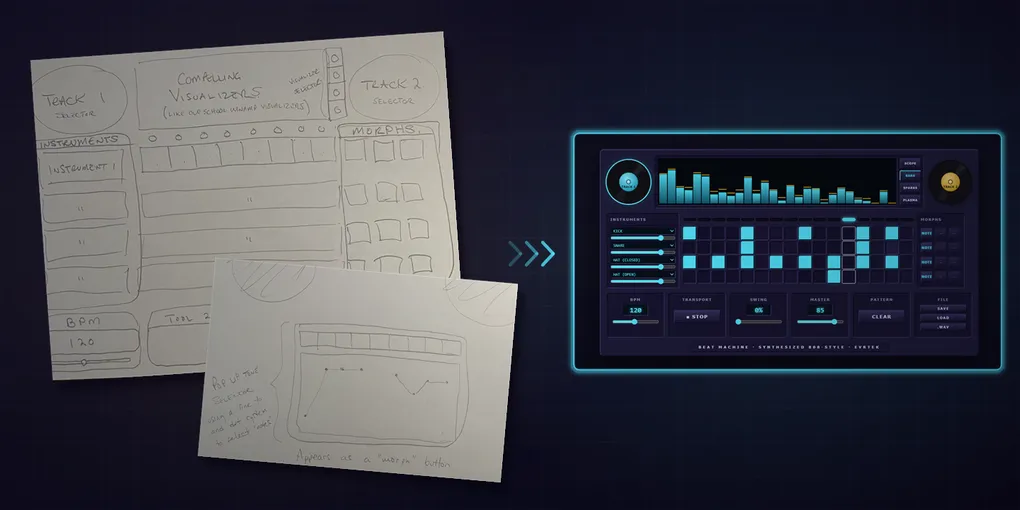
With a good night’s sleep in the rear view and the feeling returning to my feet, the day began with a visual of what I wanted to create. With a paper and pencil I sketched a beats generator, snapped some pics of my crude caveman drawings and uploaded them to the Grid. I knew we’d need some sound samples, some programming APIs, and hoped they might exist online somewhere in a free-to-use or open source capacity. I told the MCP to release some scouts out onto the net and report back with options we could use in our app that wouldn’t land us in endless legal battles. The MCP’s minions pulled in dozens of resources and organized them by licensing type. This took minutes instead of what would have been days of scrubbing the net, scrubbing licensing data, evaluating use cases — the list goes on. But can you trust what you receive? Every assertion included a paper trail to follow and confirm what was found. Amazing stuff really. In the end, we decided to go full synthesis vs. samples. Everything made from math — sounds pretty cool!
Trust but verify!
With assets in hand, it seemed like this might be a good time to hire an engineer. The MCP agreed. CLU was born onto the grid. His job was to engineer, and over-engineer, new apps. The MCP maintains the final review of anything that is intended for public view (my approvals pending, of course), but with all that work on his plate, another program needed to take over the grindy bits. I uploaded my cave drawings, gave CLU a basic idea of the plan and asked what else he needed from me. He needed a lot. CLU fired back with eight items that needed clarity before we could build anything. I read the questions — they were good. Thoughtful questions that illustrated the fact that my scrawls had in fact been perfectly interpreted. I must be an artiste! With answers in hand, CLU built a basic model. It was rough, but that’s what a first draft should be. We iterated a little until things seemed functional. From there, we needed to amp up the style. Cue up Yori for the handoff.
Yori was passed copies of all the working files and received a creative dossier that CLU and I had settled on. She went to work… and laid out another dozen or so items that needed some additional review. Again, all the questions were well phrased, thoughtful, important. Nothing was trivial, and every question came with a well-planned suggestion. Some of the suggestions I liked; others got me thinking of alternatives. This is brainstorming with a direct line to data — think Matrix, but less plugs coming out your head. A few samples popped up in the chat shortly thereafter and things seemed to look great. Time to pass things back to CLU to build.
CLU is an overachiever — I can see this already. He built the app and then proceeded to hire 11 subcontractors (adversaries) to test it, pick it apart, and critique his work from top to bottom. Maybe a little overkill, but it did uncover several issues that needed fixing before launch. Having a system that can beta test itself hundreds of times against specific pass/fail guidelines is incredibly powerful. Some foreshadowing though: my son found issues in the final release within minutes of using it. I guess there’s more work to do on having AI act like a human.
With all the pieces falling into place over the span of the day, the project was truly taking shape. Yori took another quick look at the final product and tossed in some last-minute feedback. Tweaks were made and the MCP was given the green light to go live! In my excitement I showed my son. He liked how it worked and started to play around. In less than a minute the sounds were distorting, the interface was zooming in and out (double taps on iPads have their own function… gahhh…), and my app was broken… This is why apps — even AI-built apps — need humans to review them, and maybe abuse them. It’s critical.
We’ll be working on updates over the week to get the music generator more capable and less clunky on iOS, but it’s still an incredible start!
This process doesn’t feel like working with a computer. As I’ve mentioned before, I’ve been working with computers my whole life. This is different.
-Evrtek
The project in numbers: 2 pencil sketches → 1 shipped instrument in ~a day · 8 clarifying questions · 9 repo commits · 11-agent adversarial fleet, 7/7 confirmed findings fixed · 10 art findings · 3 skins · 5 acceptance criteria · 4 programs on the roster · 0 samples.