Wait, I've got a slider for that!
A common criticism of generating something with AI is that you don’t own the work at the end of the project. While often this is considered through a legal ownership lens, I’ve found myself considering it more from the philosophical standpoint. How much of you is really in the project?
Today CLU and I fired up the workbench and turned our sights on a new build. The next arcade cabinet to join the fleet. It was one of the ideas that had spawned the day before while I was walking by a sportsplex. How about a soccer game? Not a full game, what if it was just the penalty kick. One on one, kicker vs. goalie. How do you make a short repeatable moment interesting? How do you compress into an arcade game all the skill, strategy, anticipation, nuance and instinct that soccer players employ in those few seconds leading up to and during a penalty kick? How do you keep players engaged and looking for one more click?
These are all questions I don’t think about often. As a gamer in my youth I wasn’t thinking about what made me want to play a game longer, I wasn’t analyzing the psychology of the game. Some games were just more interesting. I mean who didn’t love Paperboy on the NES? Now I have a tool that can not only teach me those concepts but can help me apply them to my specific use case.
Saving Money - still important
This is my first build in 5 days. I’ve been spending all sorts of time and energy building infrastructure to reduce token burn. I guess I better put some of it to the test. After rezzing all my agents on a clean grid, I called on CLU to start taking notes. Remember, we don’t build from the first words spoken, we draft, we discuss, we outline and schedule. Once we have a well-documented foundation, then it’s time to build. This saves time and effort. As we know from our last post, effort costs money. We’ve also learned that skill levels cost money. Let’s try a build on Opus, see how it works.
Collaboration is cooperation
CLU is always ready and willing to take your idea, mash it up, twist and turn it, and spew it back at you with 6 other things you probably didn’t think of. He’s careful to track the items you’ve confirmed and those that are still awaiting input or approval. Without his structure and organization system, a build like this would take twice as long to scope (or longer).
The foundation of the game was simple, kick a ball. We batted around basic ideas of how to make that interesting. You should be able to aim. You should be able to choose from kick styles. The goalies should have scaling levels of difficulty. And so on. The words and ideas just flowed out of me like an unyielding stream of consciousness. But how is it interesting and how do you get good at it? A breakthrough… It’s like Punch-Out!! Explaining things to another human is easier if you can compare it to something they already understand. AIs are no different. As soon as I pressed send on that message, CLU really got where I was going with this. The game needed to feel unique every time you played it but also, most importantly, you needed to be able to master it! Once you learn how your goalie reacts to you, you can own him.
Build in ownership
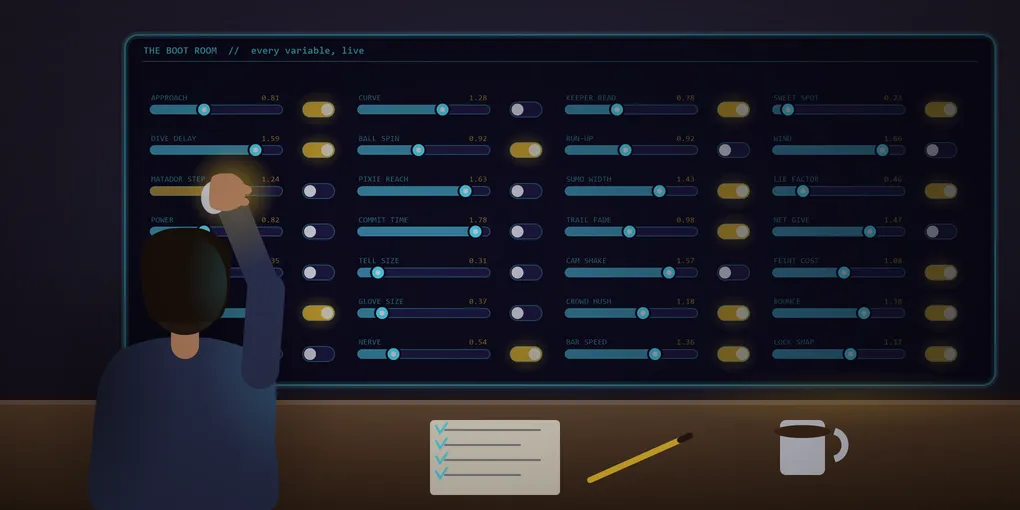
To make a project feel more like you “own” it, you need to have some sort of control over it. If I don’t have the knowledge to build the thing, what can I do to stay deeply rooted in the game’s core? Easy, build in the ownership. CLU had a full plate of build orders and just before I let him loose, one more command. “Build me a GUI interface that lets me modify every variable stored in the game on the fly without needing to send the request back to you”. This single sentence changes everything. CLU called it THE BOOT ROOM — football’s name for the back room where the staff argued about how the team should play. The shell of the game belongs to CLU, the ideas and now all the fundamental building blocks for the game belong to me. When a mechanic feels wrong I’m tweaking it. If it feels right, I’m stamping it ready for release. I get the final say and that say comes with precision down to the last detail. If we want to add a new mechanic, CLU says no problem, and I’ve even got a slider for that.
The next big arcade is still a long way off, there’s so much to do and tweak and so many play tests to run. When the final build goes live and the arcade cabinet lights up begging for the first coin… I’ll own it.
-Evrtek